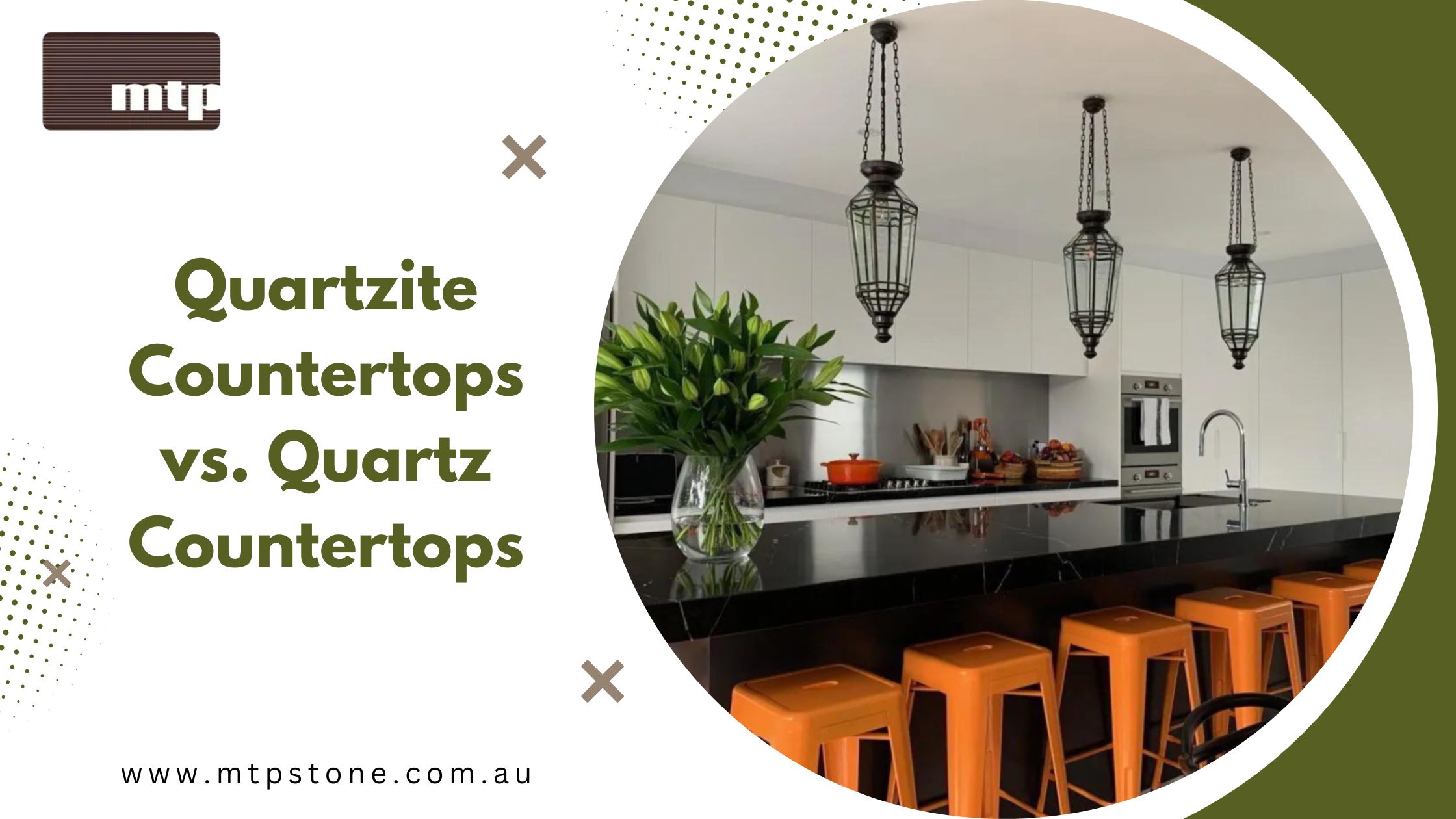
The options can be difficult when it comes to selecting the perfect countertop for your kitchen or bathroom. Among them, quartz countertops and quartzite countertops are the most popular choices. They have similar names but differ greatly in composition, cost, maintenance, durability, and look.
To know more about the difference between these materials, be with us, MTP Stone, till the end of this blog. Here we are going to discuss both countertops, their features, and the factors that affect the cost. Let’s explore!
What are Quartzite Countertops in Australia?
The sturdy nature of quartzite makes it a popular choice for homeowners to use as countertops because it exists among the world’s hardest minerals. Stone companies extract sandstone directly from the earth’s crust to create this mineral product.
This stone exhibits both excellent resistance to heat and extended durability. The material outlasts quartz, thus successfully blocking moisture from reaching natural stone surfaces. Quartzite brings both sophistication and aesthetic charm to kitchen and bathroom countertops.
Homeowners choose quartzite frequently for its distinctive marble-like veining because it offers an organic appearance together with strong durability.
Key Features of Quartzite Countertops
- Heat Resistance: The material’s heat composition makes it ideal for kitchen applications because it can withstand high oven temperatures.
- Natural Beauty: The distinct quality of every quartzite slab results from its one-of-a-kind patterns and colors.
- Stain Resistance: When properly sealed, quartzite demonstrates strong resistance to staining, but homeowners should maintain this beauty through continued care.
- Superb Hardness: Quartzite can withstand daily wear and scrapes.
Pros of Quartzite Countertops
- It is UV-resistant.
- Each slab of this material is unique.
- It is identical to marble.
- Highly durable and heat-resistant.
Cons of Quartzite Countertops
- Too expensive.
- It is porous, so it is susceptible to staining.
- It’s quite dense, making it difficult to install.
- It requires regular sealing and maintenance.
What are Quartz Countertops?
Quartz is an engineered, man-made stone made from ground quartz and resin to keep it together. It is a non-porous, easy-to-clean, stain- and scratch-resistant material that is good for countertops.
The cost of quartz falls below the price of quartzite, yet the stone lacks the heat resistance characteristic of baking sheets and hot pans. Cleaning this material requires only a damp cloth.
Manufactured quartz allows producers to deliver consistent design possibilities coupled with wide color selections, which makes it suitable for contemporary countertops.
Key Features of Quartz Countertops
- Durability: While not as tough as quartzite, quartz stands strong against regular household use.
- Wide Variety of Designs: A wide range of quartz displays various colors and patterns that duplicate granite or marble effects.
- Low Maintenance: To maintain this material, owners simply need water and soap for cleaning, and basic care is minimal.
- Non-Porous Surface: A non-sealed quartz surface remains impervious to both staining and bacterial intrusion.
Pros of Quartz Countertops
- This material demonstrates non-porous characteristics combined with scratch resistance.
- The material offers extended design choices and various color possibilities.
- Quartz is a low-maintenance material.
- The cost of quartz falls below the price of quartzite.
Cons of Quartz Countertops
- Quartz is made for indoor use only.
- It has more of a manufactured look than natural stone.
- It’s not DIY-friendly and is susceptible to heat damage.
- It lacks the natural variation of quartzite.
Quartzite Countertops vs. Quartz Countertops in 2025
| It requires great amount of energy to mine from the earth | Quartz Countertops | Quartzite Countertops |
| Vulnerability | Vulnerable to high temperatures | Vulnerable to moisture and stains |
| Resistance | Resistant to moisture and stains | Resistant to scratches and heat |
| Durability | It is known for being scratch-resistant and stain-resistant | It is more resistant than quartz and also heat-resistant |
| Material | Quartz is a man-made material that’s composed of stone chips, resins, and pigments | Quartzite is a natural stone that’s formed from sandstone and quartz under high heat and pressure |
| Environmental Impact | It is eco-friendly as it is made of non-toxic chemicals and is largely made of quartzite | It requires a great amount of energy to mine from the earth |
| Appearance | Quartz can be manufactured in many colors | Quartzite has a limited color variation, like light grey or white with flecks of red, green, or blue |
| Maintenance | It needs low-maintenance | It requires regular sealing to prevent damage and staining |
| Stain Resistant | It has a non-porous nature. You can use a quick wipe with mild soap and water to clean | It has a porous nature. This material is more susceptible to staining |
| Lifespan | After installation, quartz countertops can last for 20 to 60 years | After installation, quartzite countertops can last for 50 to 100 years |
| Installation | Quartz is DIY-friendly in simple cases | Quartzite is heavier and denser, which requires professional installation |
Factors that Affect the Cost of Quartz and Quartzite
Some factors can affect the cost of quartz and quartzite; you must know:
- Thickness: The cost of thicker slabs of both materials may be higher than that of thinner ones.
- Installation: The complexity of the installation can affect the cost. In large kitchens with many corners and cutouts, installation can be costly.
- Rarity: Since certain varieties of quartzite are more scarce than others, their prices may rise. But, because of their hues, patterns, and decorations, some varieties of quartz could cost more than others.
Which one should you choose?
Selecting between quartzite countertops and quartz countertops depends on your priorities:
You can go for Quartzite Countertops if you value the natural beauty, unique patterns, and heat resistance. It’s perfect for people who appreciate luxurious, authentic materials and don’t mind the occasional maintenance.
On the other hand, you can go for Quartz Countertops if you want affordable, versatile, and low-maintenance options. Quartz is good for busy families and those who want modern designs that require practicality without compromising the style.
Also Read:- Top 5 Reasons Verde Guatemala Marble Is Perfect for Italian Architecture
Conclusion
You can decide between quartz countertops and quartzite countertops after reading the entire blog. Both are great options for various needs because of their distinct qualities and benefits.
You can select more suitable materials for your kitchen or bathroom worktops by being aware of the differences between the materials listed above.
Also select the ideal countertop to improve the look and feel of your home by taking your lifestyle, financial situation, and design preferences into account. Make your countertops the focal point of your ideal kitchen or bathroom!
FAQs
Q:- Is it inexpensive to buy quartz countertops rather than quartzite ones?
Ans:- Due to its extraction process and natural composition, quartzite is generally more expensive.
Q: What is the main difference between quartzite and quartz?
Ans:- Quartzite occurs naturally, while quartz is composed of natural quartz crystals and resins.
Q: Which material is more durable in Australia?
Ans:- Despite being stronger and more heat-resistant than quartzite, quartz is still incredibly durable and stain-resistant.
Q:- Is quartz countertop sealing required?
Ans:- Quartz worktops are not porous, thus sealing is not necessary.
Q:- Does quartzite stand up well at high temperatures?
Ans:- Yes, due to its high heat resistance, quartzite is ideal for use in kitchens.